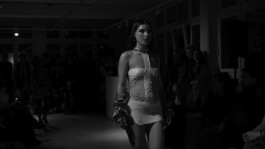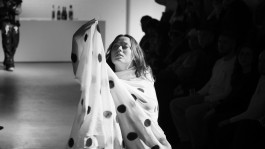
Kismet Zürich is a platform committed to providing designers with opportunities to present their collections and increase their visibility. With a focus on slow fashion and creative independence, it showcases a range of perspectives on contemporary fashion design. Supported by Zürich’s growing fashion community, its last four shows have attracted audiences from across Switzerland and internationally.
To date, Kismet Zürich has produced four runway shows, each featuring a new group of designers and staged in a different venue. Its first show, held in March 2024, was created in collaboration with Rework, a leading Swiss brand specializing in upcycled clothing and accessories. Curated by Kismet Runway, the event brought together eight designers, each presenting a collection of 5–10 pieces. Designers were given full creative freedom, from music to model selection, allowing every collection to be shown in a way that stayed true to the artist’s vision.
As Kismet Zürich continues to grow, the platform has expanded beyond Switzerland, welcoming designers from Germany, the Netherlands, China, and the United States. Each show takes months of work to bring to life and is made possible through the dedication of many collaborators. Kismet Zürich is not driven by profit, but by passion—by the belief that creativity deserves space, and that ambitious ideas deserve the chance to become real.
STRAY by Loup from Jura Switzerland: STRAY is a creative entity that embodies the spirit ofexploration and constant evolution. Each piece I create is an adventure that transforms over time,just like its creator. It’s a world I built to breathe when everything becomes too heavy, a space whereI can escape reality without truly leaving it, simply to reinvent it.All the pieces are imagined and crafted by my hands, guided by my doubts and obsessions. Eachone involves a deep exploration of materials and carries a strong message. You have to lookclosely, because many details and references are hidden, like memories waiting to be discovered.Welcome to STRAY a world born from reality, yet refusing to be confined by it.
Paradigme Carré by Aurélie and Mardane from Basel Switzerland: Paradigme Carré is acontemporary fashion and performance duo founded by Aurélie Cuenot and Mardane Gaxotte, whomet while studying Fashion Design at HGK Basel.Their practice merges performative, sculptural, and expressive elements, exploring the tensionsbetween vulnerability and control. Through satirical symbolism and exaggerated forms, theyquestion perceptions of the body and open new narrative and emotional spaces.
Studio Drained from Lausanne Switzerland: Studio Drained explores craftsmanship, with aparticular focus on leather and metal. Each creation is born from a tension between sincerity andirony, between what is controlled and what overflows. The brand cultivates ambiguity as a language,offering a lucid, sometimes casual, always sensitive vision. It’s a way of taking things seriously,without ever forgetting that, ultimately, we’re only talking about clothes.Paradigme Carré by Aurélie and Mardane from Basel Switzerland: Paradigme Carré is acontemporary fashion and performance duo founded by Aurélie Cuenot and Mardane Gaxotte, whomet while studying Fashion Design at HGK Basel.Their practice merges performative, sculptural, and expressive elements, exploring the tensionsbetween vulnerability and control. Through satirical symbolism and exaggerated forms, theyquestion perceptions of the body and open new narrative and emotional spaces.
Studio Drained from Lausanne Switzerland: Studio Drained explores craftsmanship, with aparticular focus on leather and metal. Each creation is born from a tension between sincerity andirony, between what is controlled and what overflows. The brand cultivates ambiguity as a language,offering a lucid, sometimes casual, always sensitive vision. It’s a way of taking things seriously,without ever forgetting that, ultimately, we’re only talking about clothes.Paradigme Carré by Aurélie and Mardane from Basel Switzerland: Paradigme Carré is acontemporary fashion and performance duo founded by Aurélie Cuenot and Mardane Gaxotte, whomet while studying Fashion Design at HGK Basel.Their practice merges performative, sculptural, and expressive elements, exploring the tensionsbetween vulnerability and control. Through satirical symbolism and exaggerated forms, theyquestion perceptions of the body and open new narrative and emotional spaces.
Oonie from Zürich Switzerland: Oonie’s hand-crocheted garments emerge as instinctiveexpressions of form — pieces created without patterns, guided purely by intuition and the quietrhythm of making. Each work is singular, shaped by impulse and emotion rather than designblueprints. While her collections often center on womenswear, they effortlessly expand intomenswear, embracing gentle silhouettes and details that dissolve the boundaries of gendereddesign.At its heart, her practice is a devotion to slow fashion — a revival of an ancient craft transformedinto a contemporary language of art and self-expression. Every piece bears the subtle trace of themaker’s hand, yet finds completion only through the wearer: reimagined, restyled, and made deeplypersonal, it becomes a conversation between creator and individual, tradition and modernity.
Sense13th from Shanghai China: Sense13th is built around the idea of ruined romance - the beauty that survives after collapse. Each piece reimagines clothing as emotional evidence, where the body becomes both the weapon and the wound. The brand rejects polished romance and instead embraces raw intimacy in every piece.
Christina Alvarez (Dripwife) from Puerto Rico: Cristina Alvarez is an artist and designer from Puerto Rico. Using experimental approaches, she has worked primarily with textiles. Alternating between art and fashion, she has explored styling, performance, photo/video work, shoemaking, clothing design, and soft sculpture. In her art practice, soft sculpture has become her specialization, creating plush creatures and forms that attempt to keep the inner child alive in an increasingly hostile, potentially apocalyptic world.
In her clothing, we see a wild, bold, and chaotic style. She works from the point of view of someone who feels failed by external systems and structures, from elementary school to the federal and local governments that trap Puerto Rico in a colonial limbo. Cristina has often felt bored and uninspired by the bland institutions and environments she’s had to move through. She often felt made to seem crazy for wanting something different, exciting, and better. All of this, along with her raging ADHD, has led her to what she calls “chaos and dissidence for good.”
Finding any opportunity to deliver a punchline and potentially embarrass herself for a joke, we can see a jesterly and mischievous energy throughout all of her work. While humor sits at the forefront, she places great importance on social justice, ethics, and sustainability. Never forgetting what it felt like to be a misbehaved child with a huge imagination stuck in a white box.
As a fashion designer, her pieces carry the visual language of a child. Her world exists in a child’s drawing: spiky grass, stupid flowers, a blue sky, and a sun in the corner. Little hearts and smiley faces adorn the clothes, as well as devil horns and spikes. The duality of her work lies here, the use of childlike imagination in a very adult world. We cannot separate ourselves from the pain of adulthood, but we can comfort ourselves with the child we once were.
The garments are mostly made from recycled materials sourced from Cristina’s local thrift store, which is run by a church that rehabilitates people suffering from addiction. The result is a Frankenstein of what these clothes once were. Often, originally conservative items, like polo shirts, become slutty little dresses or platforms for some irreverent message to be sewn across them. Through a series of incisions and sutures, these garments become unrecognizable, taking on a whole new identity: a skirt with the entrails of various pants exposed; denim distressed to the point of obscenity; little boy underpants turned into a dress; socks into bodysuits.
Cristina believes there is no need for new material. In a world of excess, where clothing is mass produced by the millions, everything you need is already within the confines of a used shirt or pants. So on she goes, stealing a hem, a collar, or a sleeve. She might grab a waistline and its pockets, flip the article inside out and expose its satin guts and linings, repeating the action to reflect the excess of the world in a garment. Cristina believes in the power of dress-up and role-play. Become a demon, as so many of us have been demonized for being ourselves. Become a dog, if you’ve been called a bitch in the past. Become Jesus Christ, maybe you feel like you’re carrying a cross. Becoming a character can reveal new powers you might not have otherwise been able to access.
© copyright - projectforprojects - all rights reserved
Kismet Zürich is a platform committed to providing designers with opportunities to present their collections and increase their visibility. With a focus on slow fashion and creative independence, it showcases a range of perspectives on contemporary fashion design. Supported by Zürich’s growing fashion community, its last four shows have attracted audiences from across Switzerland and internationally.
To date, Kismet Zürich has produced four runway shows, each featuring a new group of designers and staged in a different venue. Its first show, held in March 2024, was created in collaboration with Rework, a leading Swiss brand specializing in upcycled clothing and accessories. Curated by Kismet Runway, the event brought together eight designers, each presenting a collection of 5–10 pieces. Designers were given full creative freedom, from music to model selection, allowing every collection to be shown in a way that stayed true to the artist’s vision.
As Kismet Zürich continues to grow, the platform has expanded beyond Switzerland, welcoming designers from Germany, the Netherlands, China, and the United States. Each show takes months of work to bring to life and is made possible through the dedication of many collaborators. Kismet Zürich is not driven by profit, but by passion—by the belief that creativity deserves space, and that ambitious ideas deserve the chance to become real.
STRAY by Loup from Jura Switzerland: STRAY is a creative entity that embodies the spirit ofexploration and constant evolution. Each piece I create is an adventure that transforms over time,just like its creator. It’s a world I built to breathe when everything becomes too heavy, a space whereI can escape reality without truly leaving it, simply to reinvent it.All the pieces are imagined and crafted by my hands, guided by my doubts and obsessions. Eachone involves a deep exploration of materials and carries a strong message. You have to lookclosely, because many details and references are hidden, like memories waiting to be discovered.Welcome to STRAY a world born from reality, yet refusing to be confined by it.
Paradigme Carré by Aurélie and Mardane from Basel Switzerland: Paradigme Carré is acontemporary fashion and performance duo founded by Aurélie Cuenot and Mardane Gaxotte, whomet while studying Fashion Design at HGK Basel.Their practice merges performative, sculptural, and expressive elements, exploring the tensionsbetween vulnerability and control. Through satirical symbolism and exaggerated forms, theyquestion perceptions of the body and open new narrative and emotional spaces.
Studio Drained from Lausanne Switzerland: Studio Drained explores craftsmanship, with aparticular focus on leather and metal. Each creation is born from a tension between sincerity andirony, between what is controlled and what overflows. The brand cultivates ambiguity as a language,offering a lucid, sometimes casual, always sensitive vision. It’s a way of taking things seriously,without ever forgetting that, ultimately, we’re only talking about clothes.Paradigme Carré by Aurélie and Mardane from Basel Switzerland: Paradigme Carré is acontemporary fashion and performance duo founded by Aurélie Cuenot and Mardane Gaxotte, whomet while studying Fashion Design at HGK Basel.Their practice merges performative, sculptural, and expressive elements, exploring the tensionsbetween vulnerability and control. Through satirical symbolism and exaggerated forms, theyquestion perceptions of the body and open new narrative and emotional spaces.
Studio Drained from Lausanne Switzerland: Studio Drained explores craftsmanship, with aparticular focus on leather and metal. Each creation is born from a tension between sincerity andirony, between what is controlled and what overflows. The brand cultivates ambiguity as a language,offering a lucid, sometimes casual, always sensitive vision. It’s a way of taking things seriously,without ever forgetting that, ultimately, we’re only talking about clothes.Paradigme Carré by Aurélie and Mardane from Basel Switzerland: Paradigme Carré is acontemporary fashion and performance duo founded by Aurélie Cuenot and Mardane Gaxotte, whomet while studying Fashion Design at HGK Basel.Their practice merges performative, sculptural, and expressive elements, exploring the tensionsbetween vulnerability and control. Through satirical symbolism and exaggerated forms, theyquestion perceptions of the body and open new narrative and emotional spaces.
Oonie from Zürich Switzerland: Oonie’s hand-crocheted garments emerge as instinctiveexpressions of form — pieces created without patterns, guided purely by intuition and the quietrhythm of making. Each work is singular, shaped by impulse and emotion rather than designblueprints. While her collections often center on womenswear, they effortlessly expand intomenswear, embracing gentle silhouettes and details that dissolve the boundaries of gendereddesign.At its heart, her practice is a devotion to slow fashion — a revival of an ancient craft transformedinto a contemporary language of art and self-expression. Every piece bears the subtle trace of themaker’s hand, yet finds completion only through the wearer: reimagined, restyled, and made deeplypersonal, it becomes a conversation between creator and individual, tradition and modernity.
Sense13th from Shanghai China: Sense13th is built around the idea of ruined romance - the beauty that survives after collapse. Each piece reimagines clothing as emotional evidence, where the body becomes both the weapon and the wound. The brand rejects polished romance and instead embraces raw intimacy in every piece.
Christina Alvarez (Dripwife) from Puerto Rico: Cristina Alvarez is an artist and designer from Puerto Rico. Using experimental approaches, she has worked primarily with textiles. Alternating between art and fashion, she has explored styling, performance, photo/video work, shoemaking, clothing design, and soft sculpture. In her art practice, soft sculpture has become her specialization, creating plush creatures and forms that attempt to keep the inner child alive in an increasingly hostile, potentially apocalyptic world.
In her clothing, we see a wild, bold, and chaotic style. She works from the point of view of someone who feels failed by external systems and structures, from elementary school to the federal and local governments that trap Puerto Rico in a colonial limbo. Cristina has often felt bored and uninspired by the bland institutions and environments she’s had to move through. She often felt made to seem crazy for wanting something different, exciting, and better. All of this, along with her raging ADHD, has led her to what she calls “chaos and dissidence for good.”
Finding any opportunity to deliver a punchline and potentially embarrass herself for a joke, we can see a jesterly and mischievous energy throughout all of her work. While humor sits at the forefront, she places great importance on social justice, ethics, and sustainability. Never forgetting what it felt like to be a misbehaved child with a huge imagination stuck in a white box.
As a fashion designer, her pieces carry the visual language of a child. Her world exists in a child’s drawing: spiky grass, stupid flowers, a blue sky, and a sun in the corner. Little hearts and smiley faces adorn the clothes, as well as devil horns and spikes. The duality of her work lies here, the use of childlike imagination in a very adult world. We cannot separate ourselves from the pain of adulthood, but we can comfort ourselves with the child we once were.
The garments are mostly made from recycled materials sourced from Cristina’s local thrift store, which is run by a church that rehabilitates people suffering from addiction. The result is a Frankenstein of what these clothes once were. Often, originally conservative items, like polo shirts, become slutty little dresses or platforms for some irreverent message to be sewn across them. Through a series of incisions and sutures, these garments become unrecognizable, taking on a whole new identity: a skirt with the entrails of various pants exposed; denim distressed to the point of obscenity; little boy underpants turned into a dress; socks into bodysuits.
Cristina believes there is no need for new material. In a world of excess, where clothing is mass produced by the millions, everything you need is already within the confines of a used shirt or pants. So on she goes, stealing a hem, a collar, or a sleeve. She might grab a waistline and its pockets, flip the article inside out and expose its satin guts and linings, repeating the action to reflect the excess of the world in a garment. Cristina believes in the power of dress-up and role-play. Become a demon, as so many of us have been demonized for being ourselves. Become a dog, if you’ve been called a bitch in the past. Become Jesus Christ, maybe you feel like you’re carrying a cross. Becoming a character can reveal new powers you might not have otherwise been able to access.
© copyright - projectforprojects - all rights reserved